‘Modern’ Takes on ‘Historical’: GBBN’s Children’s Theatre of Cincinnati Renovations
It’s been in the works for years – you might have heard of the renovations to the Emery Theater downtown, the new mainstage home of the Children’s Theatre of Cincinnati, back when Cincinnati Public Radio’s WVXU reporter, Tana Weingartner, covered the ongoing renovations here.
You might also have heard about it when the renovations were first announced in 2023, when the Children’s Theatre purchased Emery Theater, or in 2024, when construction first began. Several representatives from GBBN, the architecture and interior design firm in charge of the project, took the time to explain their experience working on the theater, now that the Emery is back open for shows.
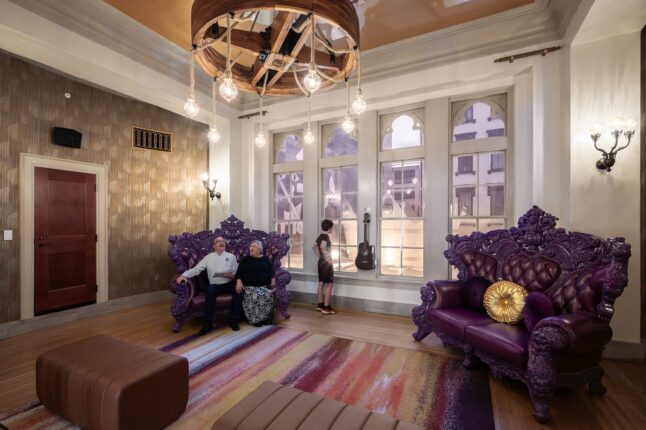
Marcene Kinney, GBBN’s Director of Arts, explained her mission at the start of the renovations. “The historic character of the theater is a treasure that has quietly sat waiting for its next life for the last 30 years,” said Kinney.
“We were fiercely committed to not just renovating this facility, but to bring it back in a way that blends its historic detailing with the whimsy The Children’s Theatre dreamed of providing its patrons from the moment they approach the theater.”
Marcene Kinney, Director of Arts at GBBN
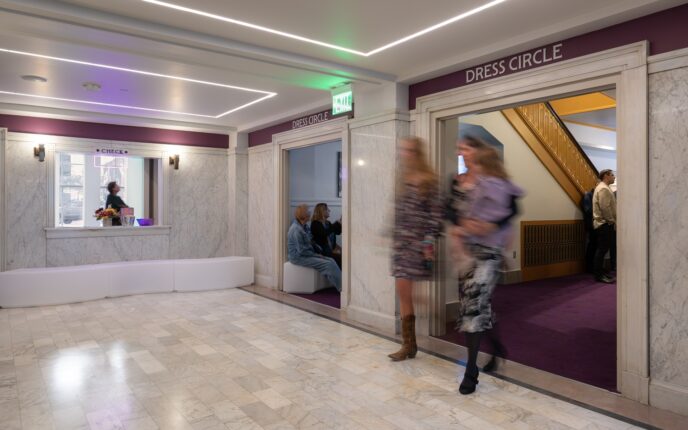
Associate Principal Architect and theater specialist, Steve Karoly, explained that preserving the historic details of the space was an essential part of GBBN’s task in restoring it. “We did not want to change or drastically alter the historic elements – from the marble ticket lobby to the interior detailing of the audience chamber,” explained Karoly.
“The details have charm and, quite frankly, given that these elements were still in their original 1911 state after over 114 years, we just had to save them!”
Before starting a project, members at GBBN come together to create a ‘vision board’ of sorts that goes beyond a written summary or survey. Kinney says it is to capture the group’s collective energy in preparation. “We began with a highly interactive vision alignment session and had a graphic manifestation of the rich conversations. That was our guide throughout the design and construction process!” she mentions.

“This was to be the new home theater for TCT, attracting patrons of all ages to an unforgettable immersive experience that cements memories. This project very quickly became focused on celebrating the Emery’s natural character while revealing moments of whimsy in contemporary ways to anchor memories of all those who come for a show!”
Troy Malmstrom, Director of Computational Design and Fabrication, was one of those in charge of ‘celebrating’ and upholding the Emery’s natural character. He clarifies the basis of his position: “My role has always been one of support here at GBBN. I’ll often refer to it as ‘design’ with a lower-case ‘d’, where the big picture design decisions (i.e., upper-case ‘D’ in the design process) have been made, and I’m here to see that all subsequent efforts are executed true to those larger design decisions,” Malmstrom explains. “This often means the design team will come to me with an idea of what they want to do, and I’m tasked with determining the best process by which to accomplish it.”
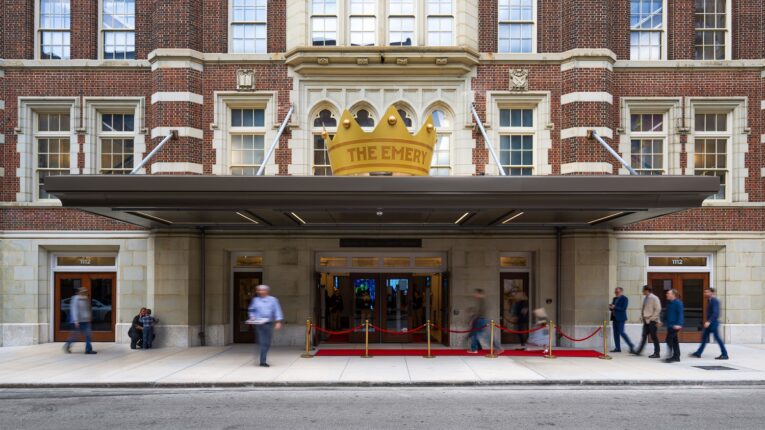
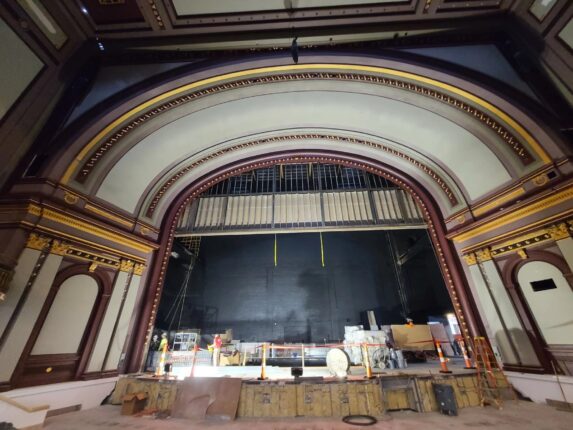
The perfect example lies within the TCT renovation: recreating the embellished historical features. To explain, we’ll delve into the details of the architecture. The entire theatre blends elements of classical Edwardian and Art Deco design styles, which means it is not quite as ornate as Baroque and Beaux Arts styles. However, it still has a distinctive embellished flair, as well as an emphasis on perfect symmetry, layered shapes, and classical proportions. This aggressive symmetry has already been noted for the Emery Theatre, as the auditorium’s fan shape contributes to the website’s proud boast of being ‘acoustically perfect’.
The significance of symmetry in the design also means the ornate details must be perfect. This means fixing all the broken florets and other elements, some of which had to be destroyed or damaged to bring the electrical and lighting up to code. Malmstrom notes,
“The primary challenge in using modern technology to recreate historical elements within the theater is pretty simple –
How do we keep the theater as true to its original design while updating it for contemporary needs?”Troy Malmstrom, GBBN Director of Computational Design and Fabrication
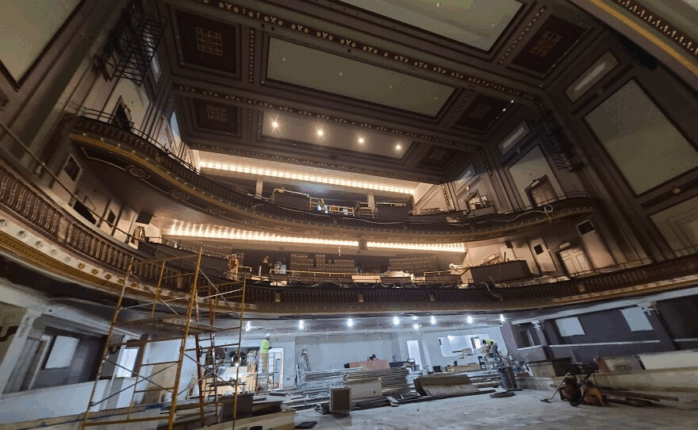
He reminisces on how the team decided to use these modern techniques to benefit them when working with these embellished features. “Two of these efforts for The Children’s Theater include figuring out the process by which to reproduce the hundreds of plaster fleurettes around the balconies as well as writing a custom design script to determine the tile patterning in the restrooms,” Malmstrom said. “In both instances, the design team approached me with a goal in mind and left it up to me to figure out the logistics of making it happen with the contractors.”
It was easily agreed upon to utilize 3D scanning and printing, though a debate arose over whether to just 3D print the fleurettes themselves or to 3D print negative molds for casting plaster versions.
“While the latter was the most historically accurate process, it was very labor-intensive and allowed for the most variation in each fleurette, so the final product was far more brittle and inconsistent,” recounts Malmstrom. “Ultimately, we decided to 3D print the final fleurettes directly and then paint them to match. With advancements in desktop 3D printing over the past 5 years, this allowed us to do it in a timeframe that worked, kept our labor costs down, and produced a reliable, repeatable product.”
Though much was done to keep designs as historically accurate as possible, plenty of exciting new technological elements were also given a space to shine. The most compelling of these are the unique stage lift, projection mapping and the LED backdrop screen.
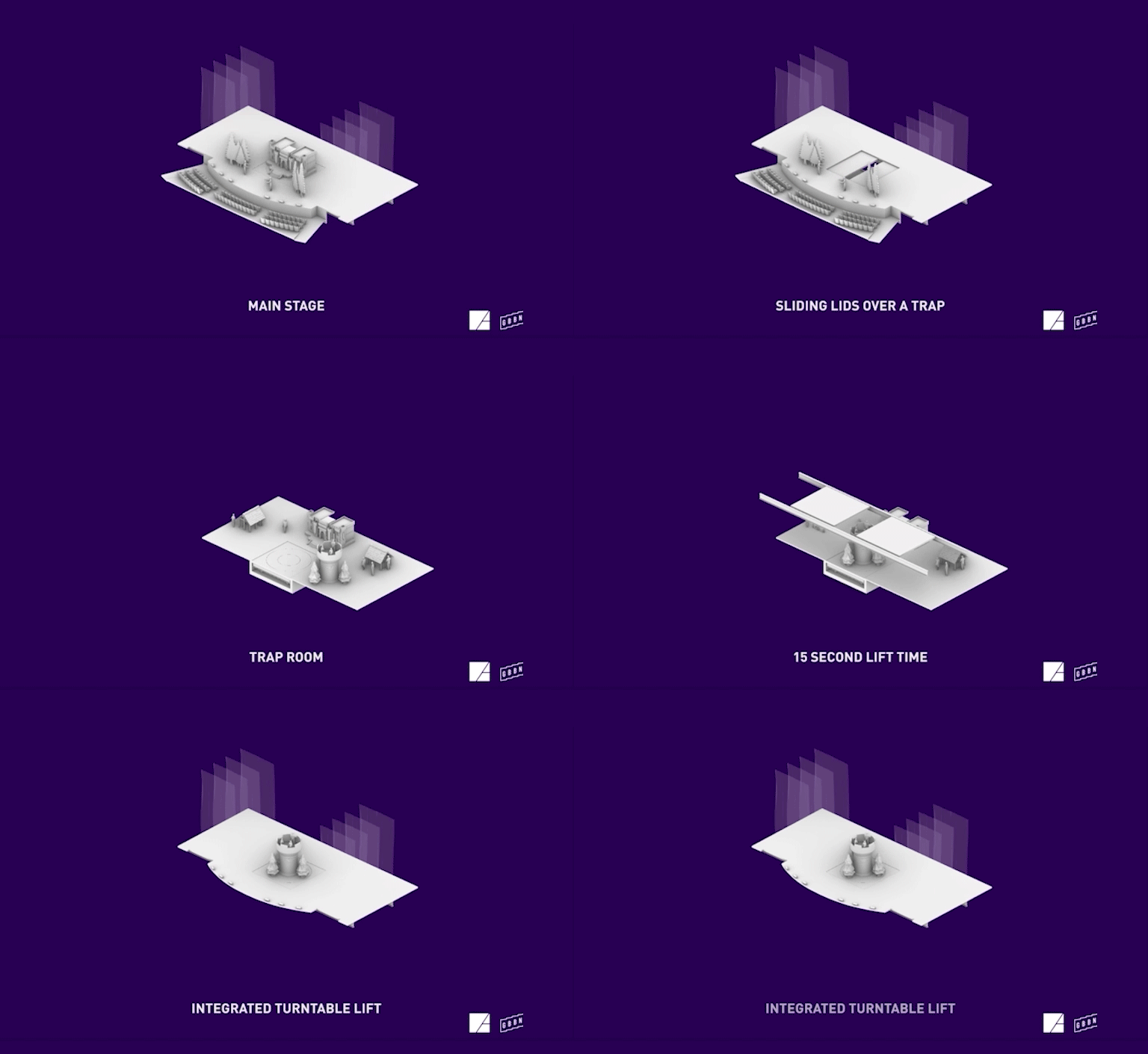
This stage lift, complete with turntable functions, allows the stage to expand vertically, addressing the challenge of limited backstage space in the theater. Originally, this meant scene storage had to be placed below the stage, so this lift makes moving set pieces easier, and as the GBBN case study notes, it is a first of its kind in a theater dedicated to children’s performance.
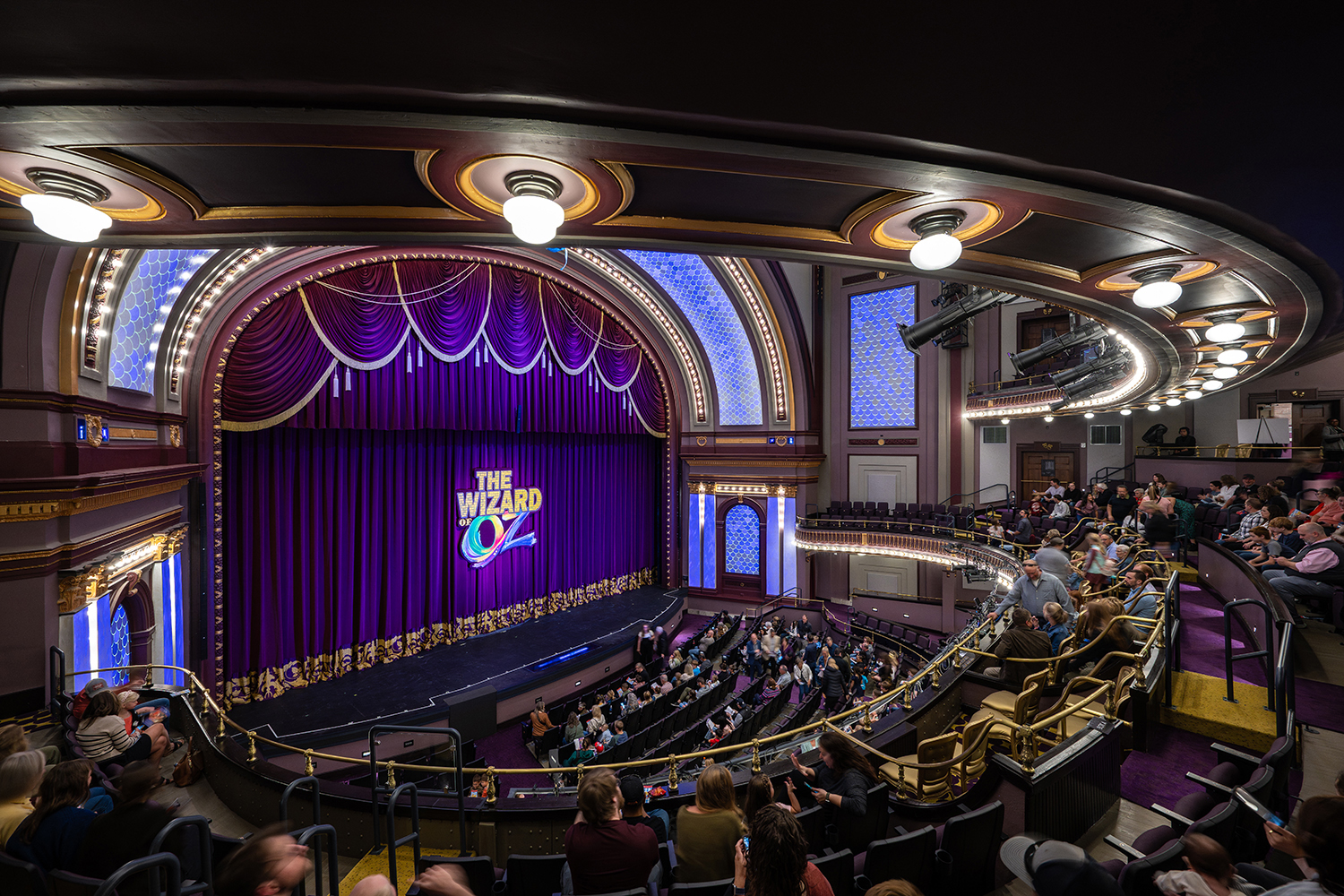
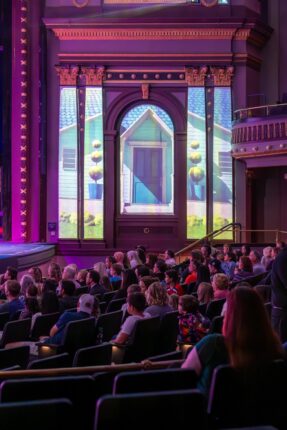
The projection mapping allows elements of each production to seep into the audience spaces without altering or erasing historical details, immersing guests in each performance. Complete with the LED backdrop screen on stage, these visual elements will, according to the website, allow the Children’s Theatre to surround audiences for The Jungle Book in a tropical wilderness environment, while Little Red Riding Hood audiences will be surrounded by a forest.
Below, the projections showcase a blue-tiled ‘brick’ pattern.
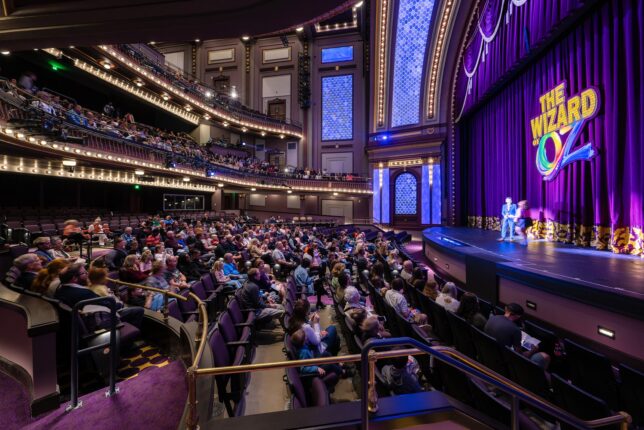
Kinney displays this example, now that the theater is open for production. “The first show, The Wizard of Oz, just finished! It was a tremendous first show where The Children’s Theater was able to use all the new theatrical equipment that is the first of its kind in the country,” she remarks. “The experience is truly immersive and opens new worlds to every patron!”
Karoly adds, “I’m truly in awe that the Children’s Theatre design and construction team was able to save this historic building to the level we did with the budget available for today’s construction costs.


“After so many years of studies, seeing the space come alive again during the first performance, with the Children’s Theatre production team pulling out all the stops, was simply remarkable.”
Steve Karoly, GBBN Associate Principal Architect
Malmstrom comments, “My favorite aspect of the final theater is the incorporation of this current technology to reproduce these historic elements, and no one even knows.
“Often when new technology is incorporated, you expect it to be the star of the show (and elements such as the projection mapping graphics, digital backdrop screen, and stage lift all are), but much like an art gallery, the theater itself is simply an armature for what people came to see – the performance.”

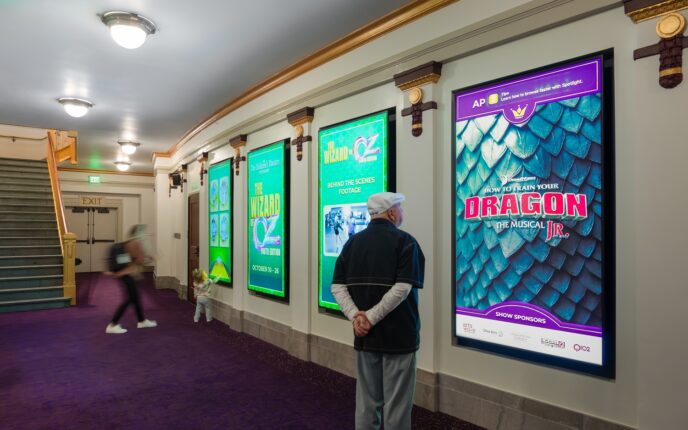
The Children’s Theatre’s next production starts early December, a festive rendition of Elf in time for the holidays. It will be followed by Diary of a Wimpy Kid: The Musical in February, followed by How to Train Your Dragon: The Musical Jr in April. For more information on showings and tickets, you can visit the Children’s Theatre’s website.
For more on the Emery Theater renovations, or GBBN’s other projects, visit their case study and website.
“We at GBBN are incredibly proud to have accomplished this project (with our partner Terrex Development & Construction) for The Children’s Theatre, our city, and every patron that visits from well outside our city’s boundaries!,” exclaims Kinney.
“We’ve brought a jewel back to our city’s crown, giving her life for the next 100 years.”